
As the year tilts toward its close, time begins to feel strange - folding in on itself, full of echoes. The days blur, the light softens, and I find myself looking back on what has unfolded in recent years, on what has lingered. Which moments, which books, have stayed? Thankfully, there are many. I plan to write more about them in the months ahead, but for now, I’ll begin with one that continues to shimmer for me: Mrs. Dalloway.
Why her, now? Maybe because Woolf’s novel has always felt like a companion to the in-between seasons - the thresholds where memory and anticipation mingle. It’s a book that measures life not in grand events but in the delicate pulse of an afternoon, in the hush between thoughts.
I first wandered into Woolf’s world during a season of uncertainty. I remember the quiet awe of realizing that she understood something I’d only half-felt: that the ordinary holds everything - clarity and confusion, joy and ache, all pressed together in the same moment. The city’s heartbeat in her prose felt like my own.
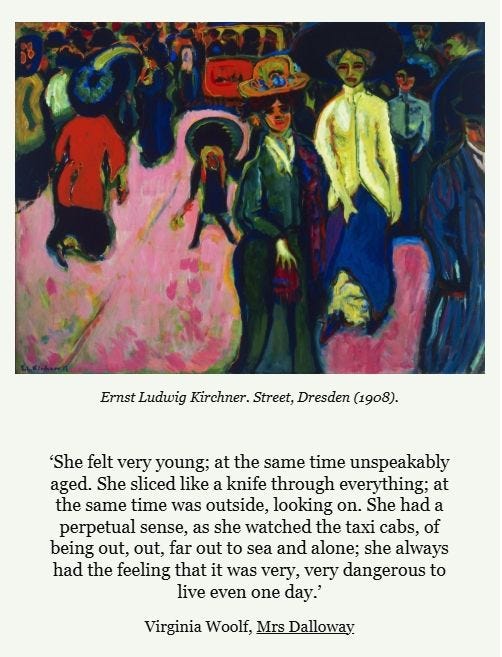
Over the years, returning to Woolf in general, or Mrs. Dalloway in particular, has become a kind of ritual, especially when I feel unmoored. Each reread opens a different door. Woolf collapses time so gently that you hardly notice when you’ve slipped from the present into memory, from one consciousness into another. Past and present start to hum on the same frequency, like two notes vibrating through the same chord.
She teaches me to be here, to pay attention as if life depends on it.
“To see life as it is, bright yet fleeting,” she writes. “For Heaven only knows why one loves it so, making it up, building it round one, tumbling it, creating it every moment afresh…”
I think of Clarissa walking through London, and I see traces of myself in her stride: the way she gathers beauty out of distraction, how she turns loneliness into observation. Mrs. Dalloway reminds me that the smallest gestures - buying flowers, greeting an old friend, noticing the way sunlight lands on a window - can contain entire worlds.
There’s a quiet courage in that, in choosing to find meaning without demanding resolution. Clarissa’s loneliness feels familiar, like a shadow that keeps pace beside me. Yet Woolf never writes her as tragic. Instead, she insists there is “a dignity in people; a solitude”. We are always brimming and always alone, yet for a moment - through a glance, a word, a shared silence - we touch something eternal.
When I read Woolf now, I find myself slowing down. Her sentences resist hurry; they invite you to listen to the rhythm of thought, to notice what flickers just beneath the surface. Every rereading feels like a lesson in tenderness - for the world, for other people, for the versions of ourselves we keep revisiting.
Maybe that’s why Mrs. Dalloway feels like a winter book to me. It’s full of light, but it’s a thin one, the kind that arrives late in the day, turning the ordinary strange and sacred for a moment before fading. Reading it at year’s end, I start to see my own life reflected in its shifting mirrors: the way joy and sorrow coexist, the way time loops back, the way a single day can contain an entire existence.
And when I close the book, I want to walk. To look a little longer. To listen closer. To let the light in - until the ordinary grows marvelous again.
Such an absolutely beautiful work of art - it’s genuinely rare for me to come across a piece of writing that makes me feel like quoting pretty much every single sentence! Looking so forward to reading the rest of your Substack!
I also loved Mrs. Dalloway. I read it for a class in undergrad, so my reading was very focused and I didn’t take it in as much as I would have liked. You’ve inspired me to return to it!