
There is something deceptively simple about the Forbidden Notebook.
A woman buys a notebook. Not even openly - almost furtively, on a Sunday, when shops aren’t supposed to be open. She begins to write in it; not with any grand intention, not to produce anything lasting, but simply to record her thoughts.
And yet, from that small act, everything begins to shift.
Set in postwar Rome, the novel exists in a world that is, on the surface, rebuilding. The war is over, life has resumed its routines, families have reassembled themselves into something resembling normality. But beneath that, there is a quiet tension - social, domestic, psychological - that never quite resolves.
This is where the novel situates itself: not in the large, visible aftermath of history, but in its interior consequences. In the lives that continue, outwardly unchanged, while something more subtle has been altered.
The protagonist, Valeria, is not a revolutionary figure. She is, in many ways, defined by her ordinariness: a wife, a mother of two, a working woman who moves through her days according to expectation. Her life is structured, predictable, externally coherent.
Which is precisely why the notebook becomes dangerous. Because writing, in this context, is not neutral. It creates a private space that didn’t exist before - a space in which she can observe, question, and, gradually, detach from the version of herself she has been performing.
What begins as documentation turns into something closer to exposure - and what’s striking is how quietly this happens.
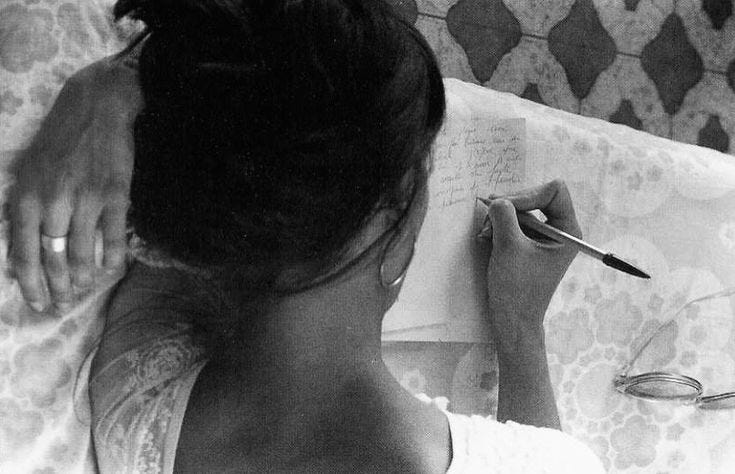
There is no dramatic rupture, no sudden rebellion. Instead, there is a slow accumulation of awareness. Small observations that begin to contradict each other. Moments that no longer fit neatly into the roles she occupies. The act of writing doesn’t transform her life immediately - it destabilises it, almost imperceptibly.
And that destabilisation is the core of the novel: because once something is written down, it becomes harder to ignore. Thoughts that might have passed unnoticed in the flow of daily life take on weight when they are fixed on a page. They demand to be acknowledged, even if nothing is done with them.
And that is where the tension builds.
Not between characters, necessarily, but within Valeria herself. Between the life she inhabits and the one she begins, tentatively, to perceive. Between what is expected of her and what she can no longer fully accept without question.
It’s an internal conflict, but one that feels deeply tied to its historical moment. Postwar Italy, particularly for women, was defined by a return to order - a reassertion of traditional roles after a period of disruption. Stability was valued, even idealised. But that stability often came at the cost of individual expression, especially in the domestic sphere.
Alba de Céspedes [author, 1911-1997] understood that tension intimately. Writing in the mid-20th century, she occupied a space that was itself transitional - between tradition and modernity, between prescribed roles and emerging forms of independence. Her work often focuses on women’s interior lives, not in a sentimental way, but with a kind of sharp, observant clarity that refuses to simplify them.
Forbidden Notebook is perhaps the clearest expression of that.
What makes it so effective is its restraint. The prose is direct, almost understated, but never flat. There’s a surgical precision to it that mirrors the act of writing within the novel itself - controlled, deliberate, quietly insistent.
Nothing is exaggerated, and yet everything feels significant.
Even the notebook, as an object, carries a kind of symbolic weight without ever becoming heavy-handed. It is ordinary, replaceable, easily hidden - and yet it holds something that cannot be easily undone. Once those thoughts exist, once they’ve been articulated, they can’t simply be folded back into silence.
And that’s what lingers after reading it.
Not a dramatic conclusion, not a sense of resolution, but the recognition of how fragile the structures of a life can be once they are examined too closely. How easily certainty gives way to ambiguity. How dangerous it can be, sometimes, to look too carefully at what you’ve always accepted.
It makes the act of writing feel slightly different: less harmless and casual, and more like a quiet form of disruption.
Which, perhaps, it always is.
este está na estante à espera do seu momento, mas deste ano não passa! só ouço maravilhas!
Writing, in this context, clarifies thoughts, gives them a kind of permanence. Reminds me a bit of The Importance of Being Earnest, the written page a mirror of sorts, a lingering invitation to explore the self and its relation to what's beyond the boundaries