
There are books you read once and admire, and books you read young and never quite escape. Wuthering heights belongs to the second category for me. I first read it when I was around thirteen (!) - far too young to understand what I was holding - and yet something in it lodged itself deep. Since then, I’ve reread it three or four times, always thinking I know what awaits me, always surprised by what resurfaces.
What I thought, at thirteen, was that it was a love story. What I know now is that it’s a love story the way a storm is rain: technically true, but missing all the force.
There is love - fierce, destructive, obsessive - but the novel is built from so many layers that calling it simply a romance feels almost naive. It’s also about inheritance, class, cruelty, revenge, wildness, and the way certain emotions refuse to age or soften. It’s about the past refusing to stay buried. It’s about what happens when two people are so bound to each other that the world around them becomes uninhabitable.
What makes the plot so arresting, even now, is how it unfolds like a closed system with its own dark gravity. Cathy and Heathcliff grow up together at Wuthering heights, half-feral, inseparable, shaped by the same wild landscape but by very different forms of love. His origin - found, unnamed, unclaimed - marks him as an outsider from the beginning, and the novel never lets you forget how fiercely he feels that exclusion. Cathy, torn between desire and duty, chooses a more stable path, and the moment she does, the story fractures. From there, everything spirals outward: resentments harden, alliances form and dissolve, and the next generation becomes entangled in the consequences of choices made long before they were born. It’s a story that loops back on itself, as if the house, the families, and the land were trapped in a cycle that no one quite knows how to break. The novel isn’t driven by plot twists so much as by the slow, relentless logic of wounded people passing their wounds along.
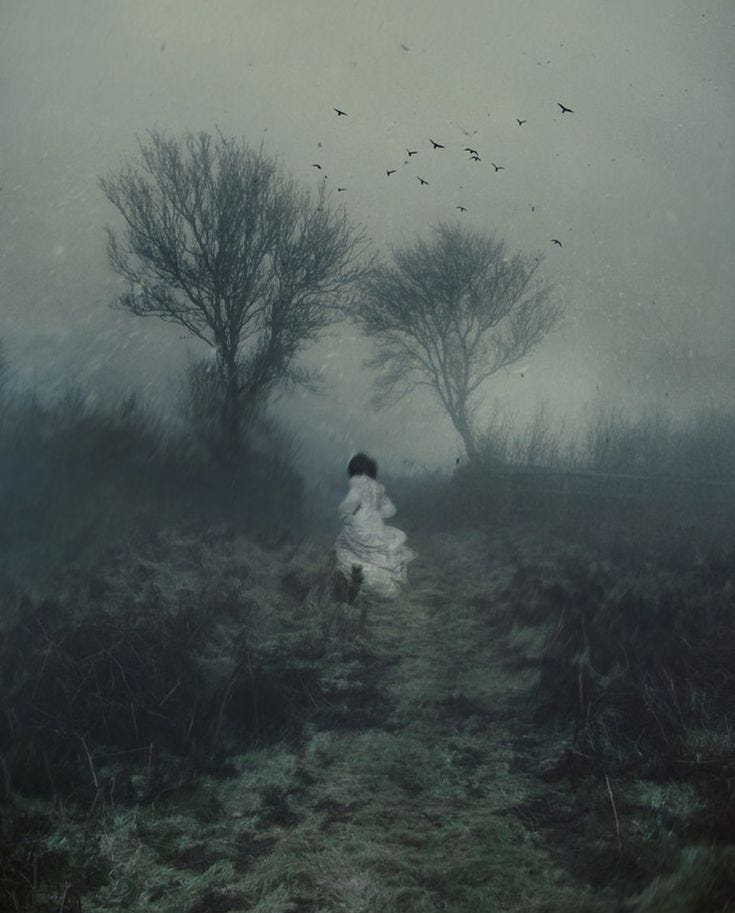
And then there is the weather.
There aren’t many novels that can use weather the way Wuthering heights does. The wind on the moors isn’t a backdrop - it’s a temperament. A narrator. A ghost. Every time the story tightens, the weather tightens. When emotions rise, the wind howls. When cruelty widens its reach, storms break open. The landscape is never neutral; it amplifies and warns [for more reflections on how whether shapes novels, read this issue].
Each rereading makes me more aware of this: how Brontë lets the climate speak when the characters cannot. The air itself seems charged with longing, fury, and grief. It’s as if Cathy and Heathcliff have spilled so much feeling into the world that the land has absorbed it, weathering it like stone.
What moves me most now, on this latest read, is not the intensity of Cathy and Heathcliff’s bond - though it remains one of the strangest, rawest bonds in literature - but how the novel admits that such love cannot exist peacefully. It burns, it corrodes, it creates its own orbit. It cares nothing for the living arrangements that make ordinary life possible.
At thirteen, I thought this was romantic. Now it feels tragic: a portrait of two people who loved each other with the kind of force that leaves no room for anything else. And yet, that’s why the novel endures. It doesn’t pretend that love is tidy or redemptive. It shows love as weather: unpredictable, ungovernable, capable of reshaping the entire landscape.
Every rereading brings me back to the same thought: Brontë didn’t write about a couple; she wrote about a climate system. A storm that begins long before the first page and continues long after the last. A love that is less an emotion than an atmosphere.
Perhaps that’s why the book still feels alive to me. It changes with me. It grows darker in some places, clearer in others. It challenges me differently each time, revealing not just who Cathy and Heathcliff are, but who I was at thirteen, and who I am now, reading the same pages with a different heart and a different weather system of my own.
I love Wuthering Heights (so much so that I own more than 20 different editions of it) and I believe it is actually more about intergenerational violence and trauma and the possibility of breaking the cycle than love (even if a destructive one), but I really did like to read your perspective. Thanks for sharing!