
Some writers don’t describe the world - they recreate it. Borges is one of them. His work feels less like literature and more like a living map of thought: a place where time folds in on itself, where memory and imagination blur, and where every sentence seems to contain another world within it.
Reading Borges, I often have the sense that I’m not being told a story, but being invited into a pattern - an idea that keeps revealing itself from new angles. His stories are mirrors reflecting mirrors, dreams dreaming themselves, books that contain all other books. And yet, behind that vast intelligence, there’s always a quiet human ache: the fear of forgetting, the tenderness of obsession, the wish to find meaning in the infinite.
He writes of eternity the way others write of love - with awe, with irony, with the suspicion that both might be illusions. His labyrinths are not just physical spaces but ways of thinking, ways of being lost. I sometimes wonder if Borges’s true subject isn’t knowledge, but humility: the realization that to know the world fully would be to disappear inside it.
Of all his works, Fictions has stayed closest to me. It’s a book that feels like it’s reading you back. Published in 1944, it gathers short stories that are less narratives than philosophical experiments - elegant paradoxes disguised as fiction. In The library of Babel, Borges imagines an infinite library containing every possible book - every story ever written, every variation, every error. In that universe, meaning becomes indistinguishable from noise. In Tlön, Uqbar, Orbis Tertius, he invents a world created by language itself (!) - a place where idealism becomes literal, and imagination replaces matter. On Fictions, I’m struck by how contemporary it feels. Borges anticipated the digital age without ever touching a computer: the anxiety of infinite information, the vertigo of endless choice, the way reality itself becomes a text that can be rewritten. But what moves me most isn’t his brilliance - it’s his restraint. His infinity is always intimate. Even in his most cerebral moments, there’s a heartbeat behind the logic, a pulse of wonder and melancholy.
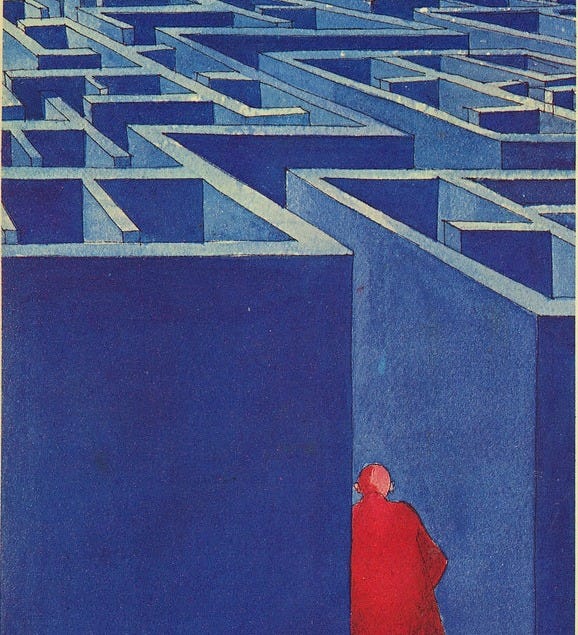
In The garden of forking paths, a man discovers that every decision creates a new universe. Each possibility is real, each path exists. It’s a story about time, but also about literature - about how every sentence, every word, splits the world open just a little. Borges shows us that storytelling is itself a form of eternity, that the act of imagining is how we resist disappearance.
I think that’s why I return to him. Borges writes as if he’s speaking to the part of us that both fears and desires infinity - the part that wants to map the world but knows the map will never be complete. His stories remind me that knowledge is endless not because we are ignorant, but because we are alive.
And maybe that’s the paradox he understood better than anyone: that to be human is to live inside a labyrinth of our own making - one built of words, mirrors, and time - and to keep walking anyway, knowing that the beauty lies not in the exit, but in the maze itself.